You know, a secure bike lock routine really starts before you even turn the key. Just because a bike comes with a lock doesn't mean it's automatically safe – if you leave the frame unsecured or just loosely wrap the lock around a wheel, you're basically asking for trouble. So find a well-lit, solid rack, and then thread that lock through both the frame and a wheel whenever you can. And keep it off the ground – that's where it's easier for someone to attack. Little details like that matter a lot. And honestly, where you park counts just as much.
Honestly, the right way to lock up really depends on your lock type, your bike's frame, and where you're parking. U-locks, chains, folding locks – they each have their own strengths, but you've gotta check the maker's instructions for proper use and care. And don't forget to remove any quick-release accessories, and try not to leave extra space inside the lock – snug is better. Take a second to give the rack a little shake to make sure it's stable. Yeah, it's tempting to rush this part when you're late, but that's exactly when you should slow down a bit. Let's be straight with each other: no lock can guarantee your bike won't get stolen, and any advice that claims otherwise is just kidding itself. You know how people keep typing 'Bike Lock Bike Lock' into Google over and over? That says a lot – they're basically asking, 'How do I make it really hard for someone to take my bike?' So that's what this guide is for. We'll look at some solid locking techniques, the usual slip-ups to avoid, and how to create a simple routine you'll actually stick to. And oh, a quick final check before you walk away? Worth it, trust me.
Choose a Lock That Matches Your Bike and Security Needs
Choose a lock for the bike you actually own and the places you leave it. A lightweight cable may deter casual handling, but it can be cut quickly with common tools. For a valuable bike or long stops in public, consider a hardened-steel U-lock or a substantial chain. Project 529, a bicycle-theft prevention and registration organization, estimates that about two million bicycles are stolen annually in North America. It is an estimate, not a complete count, but it shows why a low-cost lock may be a false economy. Fit matters. A lock should secure the frame and a wheel to a fixed rack, with little room inside for leverage.
Match security to your routine. Check the lock’s independent security rating, then compare its weight, weather resistance, and ease of carrying. A very strong lock left at home offers no protection. Short stops still count. Searches for “China Bike Lock Bike Lock” may return a broad range of products, so verify the material, dimensions, and test standard rather than trusting a product title. At the rack, keep the lock off the ground and away from easy access to its keyway. Remove accessories that detach quickly. I’d also reconsider locking only a wheel: it can leave the frame behind. Even a careful choice cannot remove all risk.
How to Secure Your Bike With a Lock
Choose a locking setup that matches your bike and where you park it.
The bars count the bike components secured in each example setup: frame, rear wheel, and front wheel. They are not security ratings. Secure the frame to an immovable rack; when possible, secure both wheels as well. In higher-risk locations, consider adding a second lock.
Find a Fixed, Secure Object to Lock Your Bike To
A good lock is only as dependable as the object holding your bike. Choose something fixed firmly to the ground or a building, such as a purpose-built bike rack. Give it a firm push and check for movement. Look closely at its base, bolts, and joints; a sturdy-looking post can still be loose or damaged. Avoid objects that can be lifted, dismantled, or slipped over the bike.
Check the whole object, not just the part you can see. A tall signpost may seem secure, but a bike could be lifted over its top. Low rails can have the opposite problem: they may not leave enough room to secure the frame. Take a moment to picture how the rack is attached. It is easy to miss a weak connection when you are in a hurry.
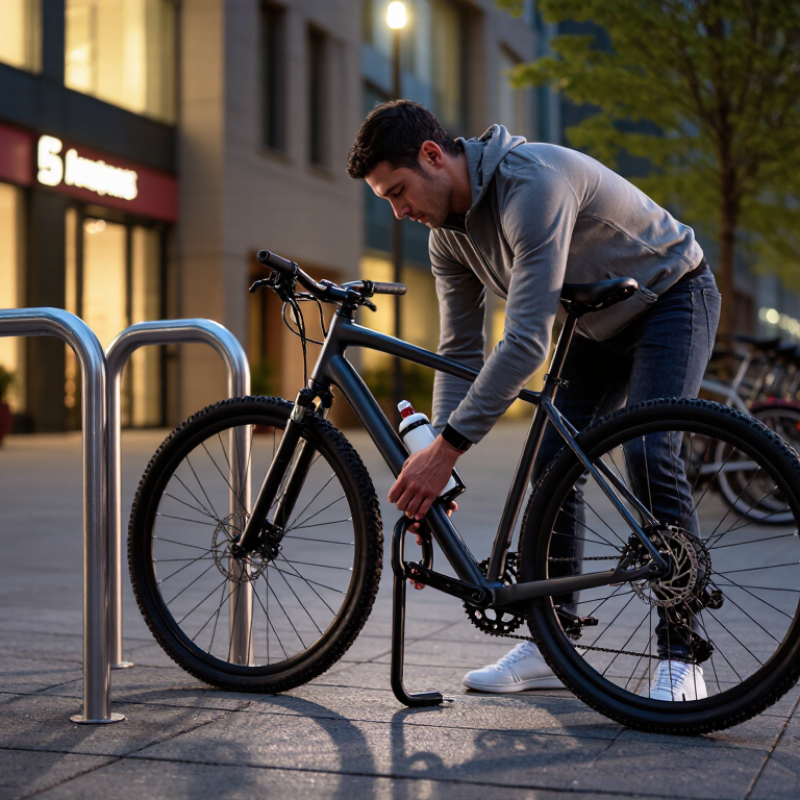
Position your bike close to the fixed object, then pass the lock through the frame and around the object. Include a wheel if the lock allows, but keep the lock clear of the ground, where it may be easier to tamper with. Make sure the bike cannot be lifted free or swung into a more convenient position. If the rack feels uncertain, choose another one. A short walk is better than lingering doubt.
Position the Bike to Limit Access to Its Lock
Choose the parking spot before threading the lock. A crowded, well-lit rack near a staffed entrance gives a thief less privacy and less time. Keep the bike close to the rack, with the lock facing a wall or another bicycle when practical. The goal is simple: make the lock awkward to reach without blocking other riders.
Small detail.
Avoid placing it where a passerby can easily kneel beside it or where the lock rests on the ground. A solid rack matters; a thin signpost or loose railing may be easier to remove than the lock.
The FBI’s 2019 Uniform Crime Reporting data recorded about 145,000 reported bicycle theft offenses in the United States. That figure reflects reported incidents, not every theft, and does not show that parking position alone prevents crime. It does underline why exposure matters.
Secure the frame and, where possible, a wheel to a fixed rack; keep the lock clear of the ground, where tools may gain leverage. Turn the keyway away from open access, and leave little room inside the lock for a tool. It is easy to focus only on buying a stronger lock. Placement deserves equal attention, though no setup makes a bike theft-proof. After locking up, check that the rack is fixed and that the lock cannot be lifted over its top.
Secure the Frame and Wheel to the Fixed Object
How to Secure Your Bike With a Lock?
Secure the Frame and Wheel to the Fixed Object
A strong lock helps only when it connects the bike to something that cannot be lifted or moved. Thread it around the frame, the rear wheel, and a fixed rack or post. If the lock reaches only the front wheel, that wheel may remain while the rest of the bike disappears. Not just the wheel. Check that the rack is firmly anchored and that the lock cannot slide over its top.
The Office for National Statistics’ Crime Survey for England and Wales estimated about 290,000 bicycle theft incidents in the year ending March 2018. That older figure is not a current forecast, but it shows why locking technique matters. Keep the lock close to the frame; extra slack can give a thief room to apply leverage. An OEM Bike Lock Bike Lock should also fit your frame and parking habits, not just look sturdy in a product photo. A small gap is easy to overlook.
Tips: Park in a visible, well-lit place. Lock the frame and a wheel to the fixed object, and remove accessories that detach quickly. Check the lock before walking away. I still think lock placement is easy to rush when you are late.
How to Secure Your Bike With a Lock? - Secure the Frame and Wheel to the Fixed Object
| Step | What to Secure | How to Position the Lock | Practical Check |
| 1. Choose a fixed object | The bike frame and at least one wheel must be attached to an immovable fixture. | Use a sturdy, permanently installed bike rack. Pass the lock around a closed section of the rack, not just a part that can be lifted or removed. | Check that the rack is firmly anchored and that the bike cannot be lifted over it. |
| 2. Secure the frame | The main frame triangle, especially the down tube or seat tube. | Loop the lock through the frame and around the fixed object. Avoid locking only a removable accessory or a wheel. | Confirm that the frame is enclosed by the lock and cannot be separated from the rack without unlocking it. |
| 3. Include a wheel | Secure the rear wheel with the frame when the lock’s size and rack layout allow. | Position the lock through the rear wheel and frame, then around the fixed object. Keep the lock close to the bike to reduce spare space. | Make sure the wheel is captured by the lock, rather than merely resting inside it. |
| 4. Protect the other wheel | The front wheel, which may be removed more easily than the frame. | Use a second lock to connect the front wheel to the frame or rack. If using a removable front wheel, place it next to the frame so both can be secured together. | Check that both wheels and the frame are accounted for before leaving the bike. |
| 5. Check the final position | The lock, frame, wheel, and rack connection. | Keep the lock away from the ground where practical, and avoid trapping cables or placing the lock against delicate components. | Pull the bike gently to verify it is attached, then check that the lock is fully closed and the key or combination mechanism is secured. |
Tip: A lock should connect the frame and wheel to a secure fixed object; locking only a wheel can leave the rest of the bike vulnerable.
Add a Second Lock to Protect the Remaining Wheel
A second lock protects the wheel your main lock cannot secure. If your first lock passes through the frame and rear wheel, use the second for the front wheel and frame. When possible, connect both locks to the same fixed rack. This makes it harder to remove a wheel and carry it away. Keep the lock clear of brake discs, cables, and moving parts. Small details matter.
Choose a sturdy second lock that is easy to carry, then thread it through the wheel and a solid part of the frame. A Custom Bike Lock Bike Lock setup still needs careful placement; no lock makes a bicycle theft-proof. Check that the rack is firmly anchored and that neither lock can slide off its end. I’ve sometimes secured the frame and forgotten the front wheel. Annoying, but easy to prevent: pause and check both wheels before walking away. Don’t leave excess chain resting on the ground, where it can be struck or twisted.
Check the Lock and Remove Loose Accessories Before Leaving
Before leaving your bike, check that the lock closes fully and opens with its key or code. Look for grit, rust, or a bent part that could stop the mechanism working. Secure the frame to a fixed rack, and include a wheel if the lock allows. Give the bike a gentle tug. A quick check can reveal a loose connection, though it cannot guarantee complete security.
Remove lights, a pump, bags, and other accessories that detach easily. Even a small handlebar pouch can be tempting to a passerby. I have learned that a rushed departure makes it easy to overlook one item; checking both sides of the bike helps. If you are comparing options using the search phrase “Wholesale Bike Lock Bike Lock,” focus on fit and ease of use, not just appearance.
Tips: Keep the key somewhere separate from the bike, and test the lock before you walk away. Check that the rack itself feels solid. Take removable accessories with you, even for a short stop. It is a little inconvenient, but I still sometimes forget a rear light.
Bicycle Lock Buying Guide: Insights from Grand View Research’s 2024–2030 Bicycle Market Report
As the bicycle market develops through 2030, convenience and everyday security remain important considerations for riders choosing accessories. A biCycle Lock should be practical to carry, straightforward to use, and suited to routine stops in different settings. Flexible cable locks can offer useful versatility: they can be looped around a bicycle and a fixed object, while their compact form makes them easy to take along. When comparing options, buyers may also consider material durability, key access, cable thickness, and whether the design is appropriate for their regular parking needs.
The Bicycle Lock With Brass Keys Cable PVC Coat Anti-theft is designed with a zinc alloy lock body, an ABS housing with a glossy metal finish, and two brass keys. Its flexible steel cable is intended for multipurpose use, with a corrosion-resistant and scratch-resistant coating to support everyday handling. Available in multiple colors and in 12 mm or 15 mm cable sizes, it offers buyers a choice of appearance and cable dimensions. Tie-card packaging makes the product suitable for retail display, while its keyed design provides a simple, familiar locking option for cyclists.
Conclusion
Securing a Bike With Lock starts with choosing a lock suited to the bike’s value, design, and parking environment. Look for a sturdy, reliable option, then find a fixed object that cannot be easily moved or lifted over. Park in a visible, well-lit place when possible, and position the bike so the lock is difficult to reach or tamper with.
Pass the lock through the bike’s frame and a wheel, then attach it firmly to the fixed object. If you have a second lock, use it to secure the other wheel as well. Before leaving, check that both locks are fully closed and that the bike cannot be rolled away or lifted free. Remove loose accessories, such as lights or bags, and take them with you. These simple steps help reduce opportunities for theft and keep your bike more secure while unattended.